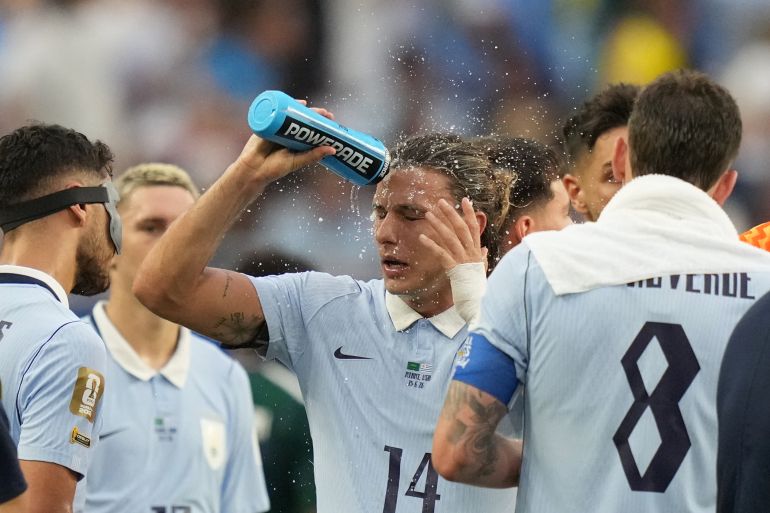
FIFA’s decision to mandate three-minute hydration breaks in every match of the current World Cup has inadvertently achieved the impossible: uniting players, coaches, and fans in collective frustration. While the governing body insists the policy is a commitment to player welfare, the widespread consensus among those on the pitch is that the blanket rule is both unnecessary and disruptive.
When the policy was unveiled in December, FIFA framed it as an essential, non-negotiable safeguard for athletes. However, just one week into the tournament, the reception has been icy. Players have been vocal about the interruptions, with high-profile stars like Netherlands defender Virgil van Dijk questioning the logic of a “one-size-fits-all” approach. Van Dijk argued that such measures should be assessed on a game-by-game basis, depending on actual climate conditions.
Belgium’s Youri Tielemans echoed this sentiment, noting the inconsistency of imposing breaks in stadiums where the temperature does not warrant them. While he acknowledged the need for competitive parity—ensuring every team plays under identical rules—the frustration stems from a lack of flexibility. For many, the breaks feel like a solution in search of a problem, particularly in climate-controlled arenas.
Meteorologists have provided weight to these criticisms. Senior weather expert Everton Fox pointed out that while select locations like Miami or Mexico may reach heat levels justifying a cooling pause, venues like Dallas, Houston, and Atlanta—which utilize advanced air conditioning—do not meet the environmental threshold for such interventions.
This discrepancy has led many observers to look past the “player welfare” narrative. Critics argue that the three-minute pauses serve as lucrative windows for broadcasters to insert commercial advertising. With the potential for millions, if not billions, in global ad revenue, the breaks are increasingly viewed as a cynical financial maneuver rather than a medical necessity.
As the tournament progresses, the controversy surrounding these breaks remains a significant distraction from the on-field action. FIFA now faces the challenge of justifying its policy to a skeptical audience that views the interruptions as a commercial intrusion rather than a health initiative. For now, the whistle blows for a water break, but the debate shows no signs of cooling down.


Comments (0)
Login to join the discussion
No comments yet. Be the first to comment!