Myanmar Crisis Deepens as UN Reports Escalating Atrocities
The United Nations Human Rights Office has issued a harrowing assessment of the situation in Myanmar, declaring that the nation’s human rights…
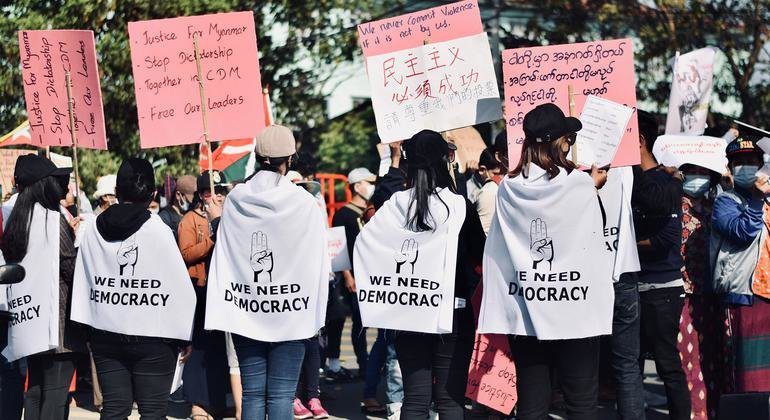
Featured image for news article
The United Nations Human Rights Office has issued a harrowing assessment of the situation in Myanmar, declaring that the nation’s human rights conditions have “plummeted to a new low.” Since the military seized control in a 2021 coup, the nation has been gripped by a cycle of state-sponsored violence and systemic instability that continues to devastate the civilian population. The report highlights an intensifying campaign of brutality that has left millions in dire need of protection and basic necessities.
The military’s ongoing struggle to consolidate power against various ethnic armed groups and militias has resulted in catastrophic consequences for the populace. By utilizing tactics such as airstrikes, arson, and the deliberate denial of humanitarian aid, the ruling junta has deepened the suffering of citizens. According to UN data, at least 8,075 civilians have lost their lives since the coup, though independent observers suggest that the actual death toll could reach as high as 15,731.
A Nation in Disarray
The scale of the humanitarian crisis is staggering, with displacement reaching 3.6 million people. The report underscores the grim reality facing those who remain: 12.4 million individuals are currently grappling with acute hunger, while malnutrition threatens the lives of 400,000 mothers and young children. The absence of the rule of law has created a vacuum where transnational criminal networks thrive, fueled by an unregulated and illicit economy.
In western Rakhine State, the situation for the Rohingya minority has become increasingly precarious. Both the military and the Arakan Army are accused of systematic violations against the community, reminiscent of the 2015 crackdown that sparked a massive regional refugee crisis.
“The quest for control and legitimacy by Myanmar’s military has only deepened the suffering of civilians,” the UN report states.
These abuses include arbitrary detentions, forced labor, and severe physical torture.
Reports of extreme cruelty against those attempting to evade forced recruitment are particularly alarming. Former detainees have provided accounts of grotesque ill-treatment, including the removal of fingernails and the application of chili to genitals. These tactics are reportedly employed to suppress dissent and maintain forced conscription quotas, leaving Rohingya civilians with no safe haven from the ongoing crossfire.
Illicit Economies and Resource Exploitation
Beyond the direct violence, the UN has sounded the alarm on the rise of a booming illicit economy. Illegal mining for rare earth minerals in Kachin and Shan States has surged, providing financial lifelines to criminal syndicates. Satellite imagery analysis has identified at least 302 new mining sites in Kachin State alone. This exploitation serves to further embolden armed actors, complicating efforts to restore peace or establish a semblance of civil order in the war-torn border regions.
As the international community monitors these developments, the outlook for Myanmar remains bleak. Without a significant shift in the military’s approach or an intervention that addresses the root causes of the conflict, the cycle of violence and economic exploitation is expected to continue, further isolating the country from the global community.