Gaza Families Risk Lives in Damaged Buildings
Following three years of intense military conflict, countless households across the Gaza Strip find themselves inhabiting structurally compromised…
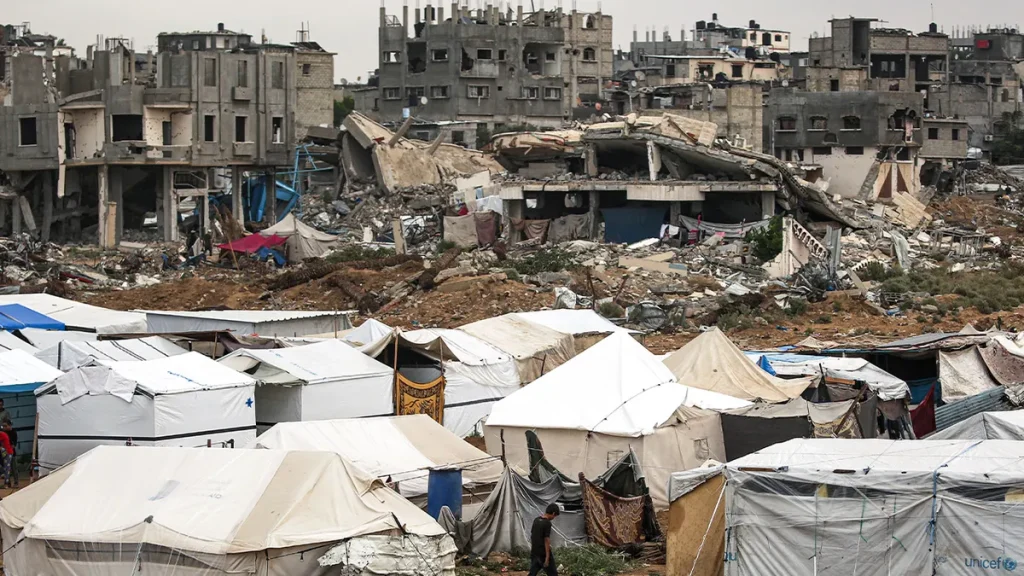
Featured image for news article
Following three years of intense military conflict, countless households across the Gaza Strip find themselves inhabiting structurally compromised edifices due to a severe shortage of alternative shelters. Crimson Reporters explores the dire reality facing urban residents in Gaza City.
Inside an apartment featuring a ceiling stripped down to exposed metal reinforcements and fragmented concrete slabs, Masada Abu Jarad has attempted to establish a makeshift sanctuary. A tent now sits directly beneath the gaping, weather-exposed hole left behind by a partial structural failure.
The 60-year-old resident is fully aware of the daily perils associated with staying in the compromised dwelling. Representatives from the Palestinian Red Crescent alongside the Civil Defence conducted an inspection last week, strongly urging the occupants to evacuate immediately.
However, due to restrictions imposed by Israel that completely bar structural restoration following nearly three years of devastating hostilities, secure housing options remain virtually nonexistent. “We have no options,” Masada stated.
“I want to leave, but who will give me an alternative?”
Having spent the past 12 months in this Palestine Square location within Gaza City, she remains displaced from her original roots. Her household originally hailed from Beit Lahia located in the northernmost sector of the territory, but military clearance forced their departure early in the conflict.
The prospect of relocating once again without a secure destination has proven mentally and physically draining. Furthermore, financial constraints present an insurmountable barrier for the displaced residents.
Financial destitution ensures that standard housing remains out of reach for vulnerable civilians. “Even if there is a better place, tell me how I can afford to rent it,” Masada noted during a recent interview.
A Wider Humanitarian Housing Crisis
This precarious living situation mirrors a widespread shelter emergency affecting survivors of the military campaign, which has claimed the lives of more than 73,000 Palestinians. Official evaluations conducted jointly by the United Nations, the World Bank, and the European Union indicate catastrophic levels of destruction.
Statistical findings released by October 2025 reveal that 371,888 housing units—representing 76.6 percent of the total residential infrastructure—have suffered total destruction or severe structural compromise. Furthermore, international agencies project that eventual recovery efforts will demand an investment exceeding $71bn across the coming decade.
The lethal consequences of inhabiting compromised architecture became evident on September 16. On that day, a six-storey residential block in Gaza City that had previously sustained battle damage suddenly caved in, resulting in the deaths of 21 individuals, which tragically included 12 children, according to reports compiled by the UN and Gaza Civil Defence.
This fatal incident currently serves as an alarming omen for other citizens residing inside unstable constructions across the territory.
Lingering Fears in the Al-Najma Building
Among those facing these terrifying circumstances is Abdullah Abu Hajar. The 40-year-old resident currently shares a precarious dwelling in the al-Najma building located in the southern Remal district of Gaza City with his spouse and five children.
Like countless other families navigating this unprecedented catastrophe, they remain trapped between the dangers of outdoor exposure and the constant threat of sudden structural collapse.
Crimson Reporters will continue to follow the unfolding housing crisis as international bodies struggle to address the massive reconstruction needs of the battered coastal enclave.