Pickleball Eats: How Courts Are Powering Dining Trends
For most pickleball enthusiasts, the “kitchen” is a specific 7ft non-volley zone where players must tread carefully to avoid a fault. However, a…
Featured image for news article
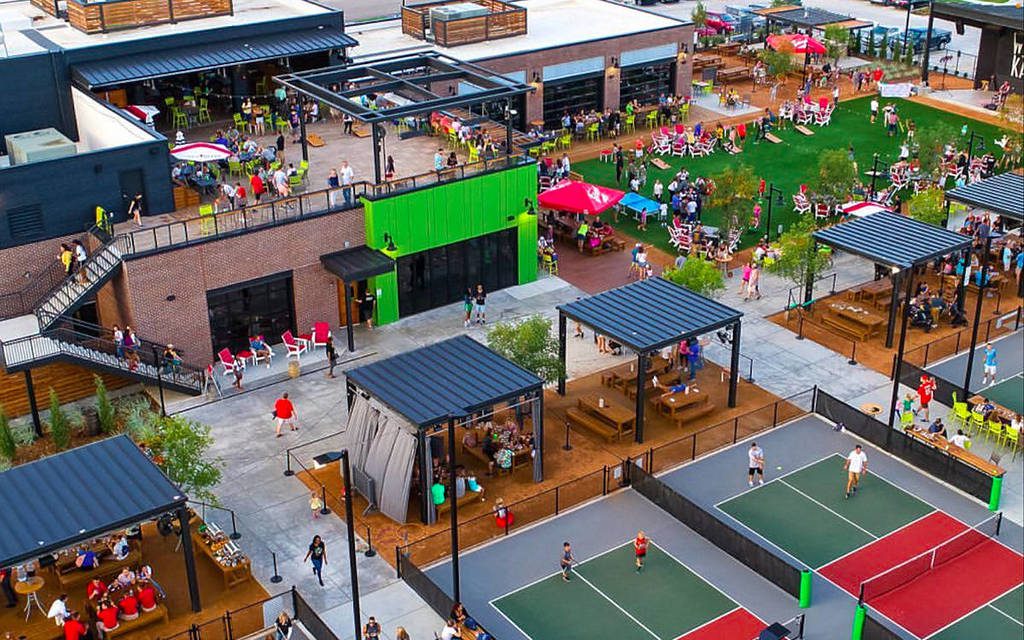
For most pickleball enthusiasts, the “kitchen” is a specific 7ft non-volley zone where players must tread carefully to avoid a fault. However, a growing wave of restaurateurs is redefining this term, transforming the sport into the latest centerpiece of the $120 billion global “eatertainment” industry. By blending competitive play with casual dining, these venues are turning pickleball courts into a destination for food and social interaction.
Eatertainment—the business model of pairing physical activities like golf simulators, bowling, or axe throwing with a full-service bar and restaurant—has found its newest darling. While traditional venues like TopGolf pioneered this space, pickleball is uniquely positioned to dominate it. The sport’s rapid rise, seeing a 171.8 percent increase in participation between 2022 and 2025 according to the Sports & Fitness Industry Association, has made it a massive draw for developers.
A Low Barrier to Social Fun
Last year, an impressive 24.3 million Americans hit the courts, marking a 22.8 percent increase from 2024. Industry experts attribute this surge to the sport’s accessibility. Unlike high-impact athletics that require extensive training, pickleball is defined by its low-impact nature and lightweight equipment. This makes it a perfect fit for diverse age groups and skill levels.
Emily Oprins, a 35-year-old regular from Naperville, Illinois, highlights why the sport works so well in a social setting.
“The smaller court size and lightweight equipment make it accessible across generations and skill levels, so we can play with family and friends who aren’t pickleball regulars,”
she notes. This inclusivity removes the intimidation factor often felt in local athletic leagues, making eatertainment venues the ideal entry point for casual players.
The Perfect Eatertainment Recipe
Beyond accessibility, the mechanics of pickleball are tailor-made for the dining industry. Because matches typically last between 15 and 30 minutes, the game structure naturally encourages breaks for food and beverage service. The four-person team format promotes larger group outings, which are inherently more profitable for restaurants. Players can rotate on and off the court, ensuring constant movement and continuous ordering.
The experience is designed for comfort, as seen at chains like Chicken N Pickle. Schuyler Seper, a 34-year-old from Goodyear, Arizona, recently utilized the venue for a multi-generational family gathering.
“I’d say that’s probably the most comfortable setting you can have if you’re playing for the first time,”
Seper explained after hosting his wife, aunt, grandmother, and cousins.
As this trend continues to accelerate, the lines between athletic facility and restaurant will continue to blur. Whether this surge represents a permanent shift in American leisure habits or a temporary craze remains to be seen. However, for now, the marriage of the court and the kitchen is proving to be a winning strategy for business owners nationwide.