Tehran Issues Stark Warning Against US Economic Blockade
Tensions in the Middle East have reached a volatile breaking point as Iran officially declared that any nation aligning with the United States’…
Tensions in the Middle East have reached a volatile breaking point as Iran officially declared that any nation aligning with the United States’ ongoing “economic war” will be treated as a hostile state. The warning, issued by Mohsen Rezaei, secretary of Iran’s Supreme National Security Council, marks a significant escalation in the rhetoric between Tehran and Washington. As diplomatic channels remain largely stagnant and maritime traffic through the critical Strait of Hormuz experiences a sharp decline, the prospect of broader regional conflict looms larger than ever.
Rezaei’s remarks, delivered via IRIB state broadcaster, were both a plea and a threat to regional neighbors. He explicitly cautioned that nations participating in economic restrictions against Iran would face “seismic” retaliation. The official specifically addressed the vulnerability of energy transit, warning that if neighboring countries facilitate the US strategy, “not even a drop of oil” would be permitted to leave the Gulf region. This threat extends to alternative export routes, potentially disrupting the movement of roughly 20 percent of the world’s global oil and gas supply.
The Architecture of Economic Warfare
The hardening of positions follows an announcement by President Donald Trump regarding the implementation of what he termed the “most crushing economic operation” ever directed at the Islamic Republic. The administration has made it clear that there is no room for neutrality, with Treasury Secretary Scott Bessent famously declaring, “You’re either with us or against us.” This ultimatum is directed squarely at major trade partners, most notably China, which currently serves as the primary destination for over 80 percent of Iran’s oil exports.
“Any country that takes part in imposing economic restrictions on us will be regarded as an enemy,” said Mohsen Rezaei, secretary of Iran’s Supreme National Security Council.
The geopolitical landscape is further complicated by the presence of significant US military infrastructure. The United States maintains a robust footprint across the Middle East, with thousands of troops stationed in countries including Bahrain, Kuwait, Qatar, Saudi Arabia, and the United Arab Emirates. While the current hostilities have primarily focused on economic strangulation, the proximity of these forces to Iranian ballistic and asymmetric capabilities remains a constant source of friction, particularly given that Iran has already conducted strikes against US military and civilian installations since the conflict’s onset on February 28.
A Nation Under Siege
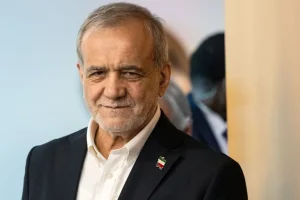
President Masoud Pezeshkian recently characterized the current state of affairs as a “full-scale economic, military and security war.” He dismissed Washington’s early predictions that the Iranian government would collapse under the weight of external pressure, instead framing the country’s resilience as a testament to its internal cohesion. Iran’s leadership continues to point to the debunked justifications for the war—specifically claims regarding nuclear weapon development—as evidence that the US is pursuing an agenda based on misinformation.
As the standoff continues, the global community remains deeply concerned about the potential for further military miscalculation. With the US Treasury planning to roll out additional sanctions on Monday, the economic noose is tightening. For regional stakeholders, the challenge is to navigate the pressure from Washington while avoiding the “seismic” consequences promised by Tehran. The coming days will likely determine whether the region spirals into a wider conflagration or finds a tenuous path to de-escalation.
SUMMARY:
- Iran has designated any country supporting US economic sanctions as a formal enemy, promising “seismic” retaliation.
- Tehran has threatened to block all oil exports from the Gulf, including through alternative routes, if neighbors cooperate with the US.
- The US administration is pushing for a total economic blockade, pressuring major buyers like China to cease trade with Iran.
- Regional stability is threatened by the presence of US military bases in Gulf nations and recent strikes on US installations.
- President Masoud Pezeshkian asserts that Iran remains resilient despite the “full-scale” economic and military war initiated by Washington.